“We have a duty not to continue doing what we've been doing so far,” says student Theresa Unverricht, winner of the Bohuslav Fuchs Award
Student Theresa Unverricht completed her Erasmus exchange at
the Faculty of Architecture, BUT, in the studio
led by Ondřej Chybík and Šárka Kubínová. She capped off her stay in Brno with a
remarkable achievement: her project, Unparked: Reclaiming Urban Life, which
explores the transformation of an unused parking garage in London, won the
Bohuslav Fuchs Award for the best student project of the year.
Theresa Unverricht arrived at the Faculty of Architecture at
Brno University of Technology without any specific expectations. However, in
her own words, Brno surprised her with its atmosphere, architecture, and the
opportunities offered by studying away from her home university. In an
interview on archSPACE, she described how stepping out of her comfort zone
was a valuable experience for her. Thanks to the different environment, she was
able to compare her own approach to design with how others work and take her
skills to the next level.
Award-Winning Project: A Parking Garage That Gives Space
Back to People
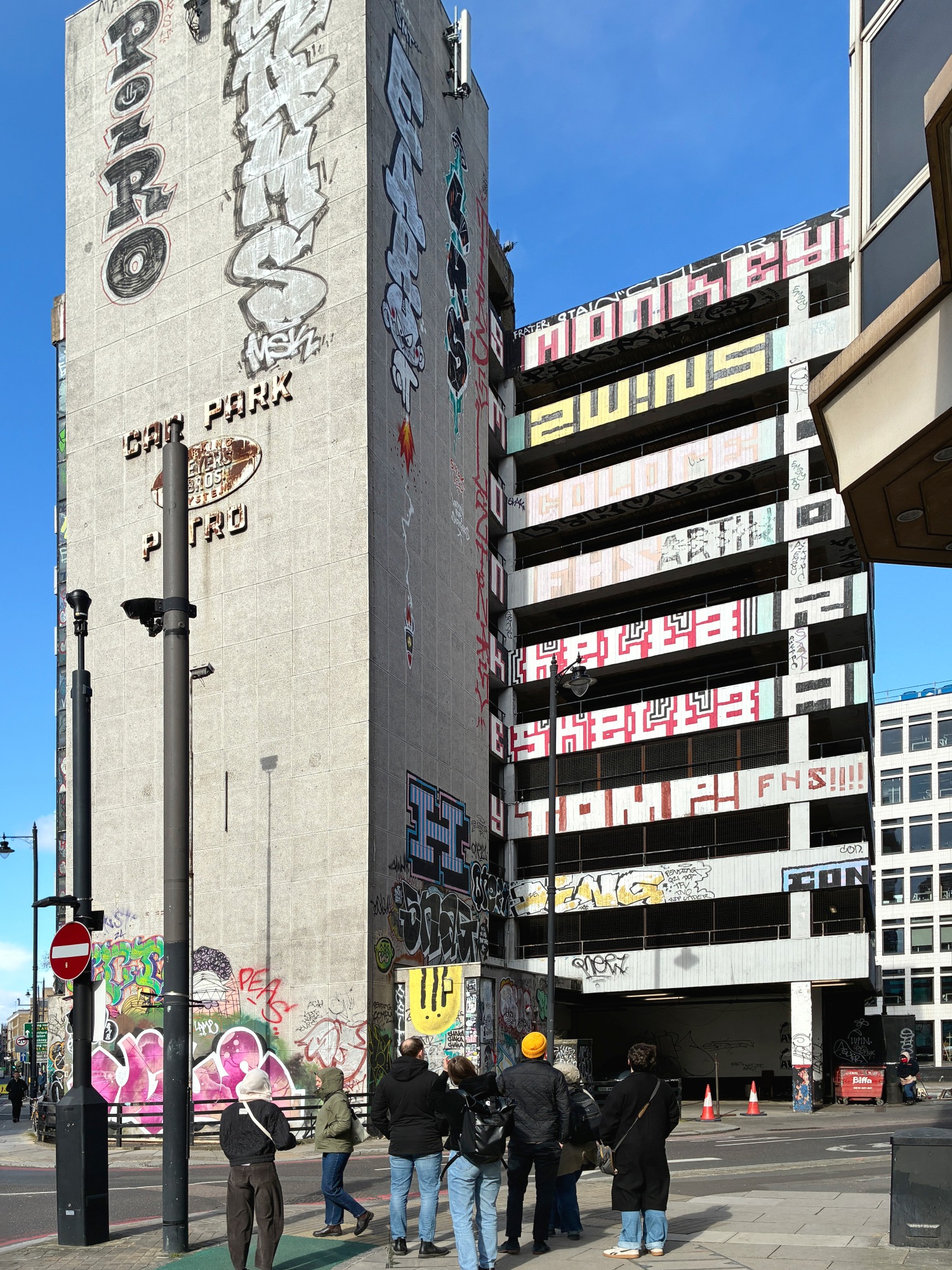
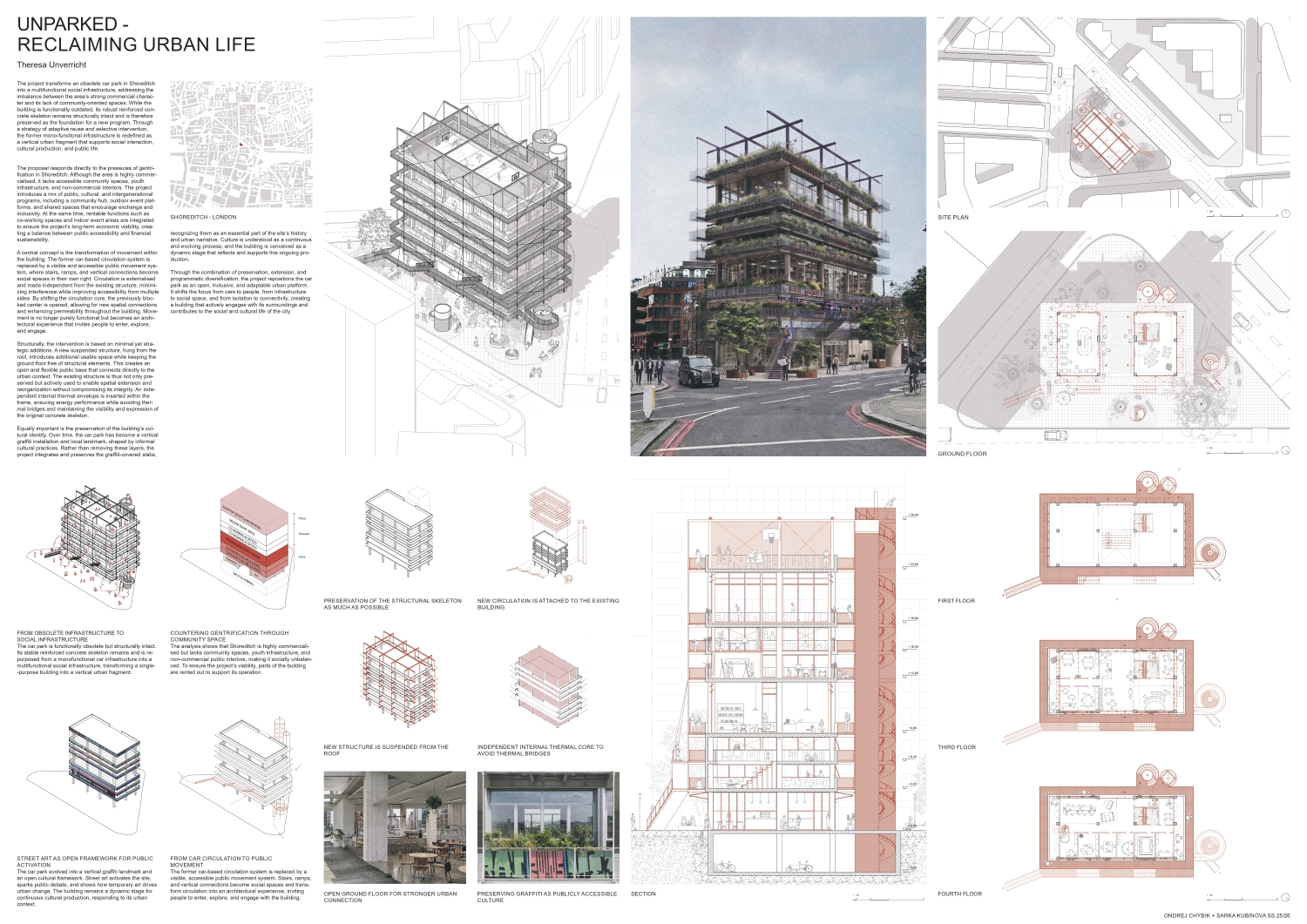
She chose adaptive reuse—the transformation of an existing building for new functions—as the theme for her semester project. This is precisely the field she has been focusing on for a long time at her home university in Germany. The project, “Unparked: Reclaiming Urban Life,” focuses on an abandoned parking garage in London’s Shoreditch neighborhood. The student is transforming the originally utilitarian structure, designed for cars, into an open urban space centered on people, community activities, and new ways of using the space.
 “In
Germany, we’re a bit further along in the discussion about adaptive reuse,”
says Theresa Unverricht | Photo: CHYBÍK + KRIŠTOF = ARCHITECTS
“In
Germany, we’re a bit further along in the discussion about adaptive reuse,”
says Theresa Unverricht | Photo: CHYBÍK + KRIŠTOF = ARCHITECTS
According to Theresa Unverricht, working with existing
buildings is one of the key tasks of contemporary architecture. In the
interview, she points out that in Europe, there is a need to consider more and
more carefully whether it is necessary to construct new buildings or whether
existing structures can be repurposed. She believes each project must be
assessed on a case-by-case basis: some parts make sense to preserve, others to
remove, and still others to add to. She sees finding the right balance as one
of the greatest challenges of architectural work.
From Car Traffic to People Flow
In the case of the London parking garage, she decided to
remove the elevator shaft, which she felt restricted the space and gave the
building an inappropriate orientation. Instead, she wanted to create a
structure that was open on all sides and connected to its surroundings. The
circulation of people became a key motif of the design. Where car traffic once
dominated, she designed a system of staircases, galleries, and open spaces that
invite people to linger, meet, and engage in other activities.
 Theresa
Unverricht: “Today, it needs to be affordable, understandable, and for the people”
| Photo: FA VUT
Theresa
Unverricht: “Today, it needs to be affordable, understandable, and for the people”
| Photo: FA VUT
Theresa Unverricht emphasizes that with similar structures,
one cannot automatically assume unlimited load-bearing capacity or easy
technical modifications. The design therefore adopts a simple and
straightforward structural logic that interferes as little as possible with the
original building while enabling new uses. It places an emphasis on
accessibility, cost-effectiveness, and a connection to the urban space.
What She Takes Away from FA BUT
Her experience at FA BUT was important to her not only
professionally but also personally. She appreciated the opportunity to work in
a different environment, get to know Brno, and participate in a studio that
introduced the topic of adaptive reuse in the context of contemporary
architectural education. She is returning to Germany to complete her master’s
degree and plans to once again choose working with an existing building as the
topic of her thesis.
 Adaptive
reuse is a fundamental challenge for me,” explains Theresa Unverricht | Photo:
CHYBÍK + KRIŠTOF = ARCHITECTS
Adaptive
reuse is a fundamental challenge for me,” explains Theresa Unverricht | Photo:
CHYBÍK + KRIŠTOF = ARCHITECTS
The Bohuslav Fuchs Award for the project “Unparked:
Reclaiming Urban Life” thus recognizes not only a high-quality student design
but also a topic that will become increasingly important in architecture: how
to responsibly manage what has already been built and how to use architecture
to reopen the city to people.
This text is based on an interview by Jan Gerych on archSPACE.
| Inserted by: | Rychnovská Anna Mgr. |
|---|---|
| Inserted | |
| Last updated |